Tue

18

Jan

2011

Some Insights on Group Buying Sites

I have some pent-up thoughts on the dynamics at work in the “group buying” space. Having cofounded a company called KangoGift (not a group-buying service, rather a service that allows people to send real gifts instantly by text message), I’ve had a lot of interactions with retailers who have been approached by and have used group-buying sites. I’ve also bumped into investors who have tried to prod KangoGift towards more of a group-buying/discounting model. I’ve given group buying plenty of thought, and it’s time for a brain dump…


Is it really group buying or just new-world coupons?


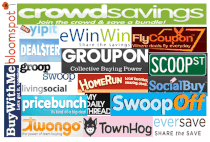
Groupon, Buywithme, LivingSocial, CoupMe, Eversave, DailyDealster. HomeRun… they’re referred to as group-buying sites, and in a way, it stands to reason. They claim that if they can get enough people to participate in a deal, they can offer a product or service at a great price – usually at 50% off or more.


But here’s the truth – they virtually always get enough customers to activate the deal. For example, where I live – in Framingham, MA -- Groupon needed 50 customers to opt in by end of day for today’s local deal to be be “tipped” – which is 58% off five car washes at a local car wash joint. Groupon probably sends this deal off to well over 10,000 people, perhaps more than 100,000 (with the way they segment their email lists, I have no way of knowing the exact number). Of course they’ll get 50 people to participate. To emphasize my point, the deal tipped before 9 AM.


To call a spade a spade, I don’t think the vast majority of people participate in the deals for the “group” aspect of the deal. They participate to get a great deal. It’s a modern-day coupon for all intents and purposes.


While I don’t think people are truly participating for the satisfaction of participating with a group, I’d certainly concede that social media has helped Groupon and the rest expand in ways not imaginable just a few years back. Deals gets posted and shared by thousands of people on Facebook every day, as well as tweeted/re-tweeted thousands of times. For a simple value prop message (e.g. "50% off your next spa treatment"), social media is a powerful marketing phenomenon, no doubt.


Some of the hidden little secrets


As someone who has talked to plenty of retailers who have tried group-buying sites, there are some interesting pieces to the puzzle that many folks don’t understand. To name a few…


It’s damn expensive for the retailer: The beauty of the group-buying model is that technically a retailer doesn’t pay a group-buying site a penny to participate in a deal. But that doesn’t mean it’s cheap. First of all, the group-buying site will insist that the retailer offer somewhere between 50-90% off. Take the car wash deal I referred to before. It was 58% off the normal price -- $25 for 5 car washes, which is normally $60. Group buying sites will then retain anywhere from 25%-50% of the sale price. With Groupon – due to its enormous marketshare – they’re probably taking 50%. Holding those assumptions, in today’s deal, Groupon gets $12.50 per unit sold, and the car wash gets $12.50. Remember, the car wash is giving away $60 worth of product. This probably is just fine for a car wash. But for a clothing store? A specialty food store? A toy store? That’s a steep price.


The “Breakage” factor: This is somewhat stunning but true. From the retailers I’ve talked to, anywhere from 20-40% of deals bought on group-buying sites are never redeemed. In the gift card business, a gift card that’s never used is referred to as “breakage.” Of course, this breakage offsets the aforementioned expense for the retailer a bit. Part of me thinks consumers will eventually wise up to breakage but another part of me knows they won't.


There can be serious buyer’s remorse: There are undoubtedly some retailers who are thrilled to bits with the customers group buying sites deliver. But I’ve heard a fair share say that they’ll absolutely never do a group-buying deal again. They get overwhelmed with customers in a very condensed period of time, or they feel like the deal cheapens their brand in the long run, or the promise of new customers that convert into repeat customers turns out to be hollow.


The copycat phenomenon


It’s truly amazing to see how many group-buying sites have come out of the woodwork. I’ve been following Groupon since early 2009. There was perhaps one other company doing something similar back then. Fast forward 20 months, and there are so many group-buying sites out there that it’s a bit absurd. It's a bit shameless as well; not only to these clones copy the business model, they copy the look and feel of Groupon's site. There are, in fact, son many group-buying sites now that aggregators are cropping up (more on that in a bit).


I guess this goes to show a few things: The entrepreneurial spirit is alive and well in America – for better and worse. Plenty of people want to build companies and hit pay dirt, and plenty of people have no qualms trying to essentially do a copy and paste.


The big little secret: It’s all about the sales force


While imitators abound, one thing that I think is under-estimated is the sales challenge involved in a group-buying site. While you can read about the how the $100 billion local advertising business is just there for the taking, trust me that it just ain’t that easy. Groupon, which undoubtedly has a tremendous amount of inbound demand from retail businesses, still needs a gargantuan sales force of thousands of people to do what it does. They have thousands of sales folks pounding the pavement from Seattle to St. Petersburg – and that’s not an easy (or cheap) thing to replicate.

.

I have to wonder what Groupon is thinking about leveraging this sales force in other ways. Employees with connections into thousands of local businesses is an absolutely awesome asset, and it could be used for more than great discount deals. I’m very curious to see how this plays out.


How will aggregators change this game?


I spent close to 10 years working at Monster.com. Among the hundreds of companies to come along to take a bite out of Monster’s lunch were the job aggregators – sites that essentially just scrape as many job boards as they can find and display all the jobs all in one spot. Two of the big ones are Indeed.com and SimplyHired.com, and frankly, they’re brilliant. If I’m searching for jobs, why go to Monster.com, Dice.com, CareerBuilder.com, MyLocalNicheJobBoard.com all separately if I can just go see all the jobs listed in one spot?


Well, group buying is just like job boards… do I want to subscribe to 23 different group buying sites or one aggregator like GroopBuy or Yipit? (some more on this trend here: http://www.dailyfinance.com/story/aggregators-will-change-group-buying/19756903/) The jury is still out.


The self-service model


To me, this is one of the most interesting unanswered questions in this space. Groupon announced last fall that they’d allow companies to create and promote their own deals. And there are new companies like Privy out there trying to enable a self-service model. On the one hand, this makes perfect sense – turn the whole thing into a SaaS model and let everyone service themselves, right? Well yeah, except there’s the reality of it all, namely…

  • Getting small business owners to do anything is a massive uphill battle. They are busy, they are often disorganized, they’re not necessarily tech-savvy, and they’re putting out fires all day. Barriers abound. Trust me! :)
  • If I’m a small business owner and I’m not getting new customers in the door by running a huge discount, is it really something I want to do for my existing customers and fans? Why would I advertise a 50% off deal through my website or Twitter feed or CRM campaign to people who are already interested in my brand? I’m not saying there’s never a reason a business owner would want to do this, but as a general rule, discounting is intended to get new folks through the doors.

It’s all fascinating to follow, and it’s going to be very interesting to see how it all plays out. 


read more 2 Comments

Mon

29

Nov

2010

How my dad lost 135 pounds (and I’m not trying to sell you a damn thing)

Do a bit of poking around online, and you can find out that the weight loss industry is anywhere from a $35 billion to $70 billion dollar a year industry, depending on whom you believe. The late-night infomercials, the Jenny Craig pre-made dinners, the diet supplement stores. Weight loss is an unmistakable national obsession.


Ironically, on the whole, we’re only getting bigger and fatter.


But I’ve got a pretty inspirational story about weight loss. And here’s the beauty of my story: I don’t want you to subscribe to my program, join my gym or buy anything with a money-back guarantee that you’ll lose 20 pounds. Honestly, I don’t really care all that much whether you lose weight. I just think it’s worth telling the story of my father’s weight loss, because I know there are lots of folks out there who aspire to lose a lot of weight.


A bit of history on my father


First some background on my dad. He’s now 71 (started losing the weight when he was 70). When I was a young ‘en, he was a big guy but not overly big. When I was a school kid, he probably weighed around 250 pounds. He could have afforded to drop 50 pounds. But he carried his weight well and did not appear to be a terribly overweight guy.


After my folks divorced and my siblings and I all left for college, my father ended up living in a number of places without significant others or a lot of friends around. Over time (and perhaps without much oversight or input from loved ones nearby), he gradually gained weight.


Throughout these years, my father was an on-again, off-again habitual dieter – like so many millions of people. He knew he should lose weight, and he’d go on diets that he’d stick with for a few months. He’d lose weight – 10, 15, 25 pounds. One time, he lost more than 50 pounds. But invariably, the weight would find its way back. No diet ever really stuck.


Over the years, my dad got big. Very big. At his heaviest, he weighed north of 360 pounds. And there were attendant health problems. He was diagnosed with a heart disease called atrial fibrillation. He was pre-diabetic. He had high blood pressure, and he had pain in his legs and feet. And the most problematic health issue was that his hip began causing him so much pain that he had to have hip replacement surgery in June of 2009. At the time of the surgery, he weighed 355 pounds.


As I write this just after Thanksgiving in 2010, my father weighs 220 pounds. In other words, he has lost 135 pounds since that surgery 17 months ago – 120 pounds since the beginning of this year. The last time he weighed that much was when he was about 44 years old.


He’s still not a triathlete. He can’t walk for great distances or go on jogs, and his hip still bothers him a bit. He’s still less than certain walking down stairs, and he keeps a cane with him. But the difference between my father of today and my father of 11 months ago is absolutely remarkable and inspiring.


The secret is there is no secret


So you’ve got the high-level details now. But perhaps you’re wondering how he did it. Well, I’ve got some bad news and some good news.


Let’s get the bad news out of the way: If you’re looking for an “a-ha” moment, you’re out of luck. There is no magic trick. No silver bullets. In fact, his story about how he lost weight is a bit dull.


Now for the good news: What my father did is within reach of anyone who totally resolves to do it. Not only that, it doesn’t cost a lot of money.


Here are the details of how things unfolded.


In January, when we weighed a bit north of 340 pounds, he had back-to-back meetings with his primary care physician and his orthopedic surgeon. They restated the somewhat obvious – that he had multiple health issues and all of them were made worse by his weight. There was one simple thing the surgeon said that stuck with my dad vividly: “We’re only trying to make the rest of your life as good as it can be.”


My father became ultra-motivated to lose a lot of weight. A nutritionist he saw recommended a low-carb diet that eliminated all high-glycemic foods. More specifically, he was to eliminate all “white foods” -- refined sugar, white flour, rice, potatoes. She asked him to keep his food intake under 165 carbs a day.


My father decided he was going to be a bit more radical than that. He aimed to keep his carb intake under 80 a day.


So what did he eat? For breakfast, he ate lox and berries. One thing I should add is that my father is extraordinarily frugal. So when blueberries were cheap, he’d have blueberries for breakfast – for weeks on end. When strawberries were on sale, it would be strawberries for weeks.


Another constant staple was salads. These salads consisted of lettuce, cucumbers, red peppers and tomatoes. He did not limit his salad intake. He made his own dressing to make sure it included olive oil, a “good” fat.


At dinner, it would be broiled or grilled chicken, turkey or fish (or at least it was at first; things changed a bit later on, which we’ll get to) with a salad or steamed vegetable dish and sometimes fruit for desert.


What did he eliminate from his diet? No cereal, no bread, no pita, no chips, no pasta or noodles -- all high glycemic food. No sugar-laden desserts like cake, pie or cookies.


He also joined a gym and started going to the gym 4-5 times a week at first. The primary exercise for him was swimming laps in the pool – the only form of aerobic exercise his recovering hip could handle. 


Quick out of the gates but then a slow-down


The weight loss came rapidly at first. He had lost around 45 pounds by April of 2010. But an interesting pattern started to emerge. He would hit these plateaus where despite the fact that he was adhering to his strict diet, he would level off and stop losing weight for 2 or 3 weeks. But then, after pushing through those stretches, the weight would start to come off again. He’d lost 90 pounds by mid-summer.


Losing more weight became more difficult after he reached 250 lbs. And when he got to 235 lbs., he hit a stretch where he stayed at the same weight for 6 weeks. So he dialed up the rigor of his diet. He essentially cut back to two meals a day, and he cut the chicken, fish and turkey out of his diet, replacing those foods with tempeh, tofu or soy milk plus small servings of lox or pickled herring for protein. He also upped his work-out schedule to every single day, and he started an aqua aerobics class (Interestingly, by his account, the working out only accounted for a small percentage of the weight loss).


Some fatherly advice


There’s no doubt that this has been a Spartan routine for my father. But the results are truly amazing. He has some pretty interesting perspectives on maintaining a regimen of this sort.


The downsides are pretty straight-forward. There was the hungriness and the temptations. But there is also perspective. “The pain in my hip is more difficult than being hungry,” my father says. And the challenge of eating less obviously correlates to less pain in his hip.


Also, his dieting experiences of yesteryear helped him on some levels. “Because I’d been on many diets, I knew I could cut out any food I wanted. In this case, I just had to stop eating a whole bunch of stuff.”


And here’s some somewhat sobering advice he has: “Eat foods that don’t taste that great. That way you’re less tempted to over-eat.”


An interesting technique he employed involved imposing rules and routines on himself: “Eat only at home and stay away from home as much as you can.” (this is probably easier for some than others). And on a related note, my father thinks “it is important to have other activities to take your mind off food, but these activities should not be stressful or cause you to just cram food down your gullet because of limited time or to comfort yourself as a countermeasure to that stress.”


Then there was the common advice to make dinner your last food intake for the day. In other words, no night-time snacks.


Did he ever want to quit?, I asked him. “Not really. I was committed.” The ferocity and frequency of food cravings subsided after a few months. And there were all kinds of other benefits aside from the psychic rewards of shedding pounds. His energy level was higher. He could walk longer distances. He stopped getting winded going up a flight of stairs.


Parting thoughts


Over the past few days (Thanksgiving and the 3 days after), he’s been off the wagon for the first time in 11 months – indulging in the gluttony of this particular holiday. But he’s totally confident he can get right back into the mode he’s been in since January. His goal is to get down to the 175-180 lb. range, at which point he says he’ll add a few indulgences into his diet – like whole grain breads and a bit of peanut butter. But he’s quick to add that he’ll only add in foods if it doesn’t result in weight gain.


This commitment and confidence is wonderful for me to hear personally.

My father literally looks like a different person. It struck me every time I laid eyes on him for the 5 days he was staying with me. Besides looking trim, he seems more animated and more in control of what he’s doing. He doesn’t slouch as much as he used to, and he doesn’t limp the way he used to. He also seems just plain happier.


Is this kind of weight loss a terrifically challenging undertaking? No doubt. Does it seem worthwhile? No doubt.


read more 3 Comments

Mon

11

Oct

2010

Future M Start-Up Marketing Boot Camp Recap

I cannot stop thinking about the all-day event I attended on Friday – Future M’s Startup Marketing Bootcamp. When your day-to-day reference point is locking yourself in your basement most mornings and remaining in solitude as you try to help build a startup, spending 7 hours immersed in great discussions and surrounded by smart and vibrant people leaves you feeling like you just got served a feast.


Of course, there were only 120-150 people at the event, which means a lot of people who may have been craving some startup marketing insights didn’t get a taste. I took pretty exhaustive notes, and in an effort to make sure anyone who wanted a bite of the knowledge doesn’t go hungry, I’m going to try summarize what we heard from the inspirational people who presented at the event. The notes that follow mimic the order of the sessions at the event.


Disclaimer: This is by no means a comprehensive review, and I’m just jotting down the things that caught my ear and got me thinking – so it’s gone through my personal filter (for better or worse). 


What's Next in Marketing -- Valeria Maltoni, Conversation Agent

Valeria is a bit of a social marketing maven, and her comments echoed comments I heard from another social media visionary, Michael Troiano (@miketrap), on Thursday night. A few themes:

  • Be playful (reminded me of Mike’s comment that you need to entertain, inform, promote – in that order)
  • You can’t think of customers as faceless targets anymore
  • The product is your marketing
  • Be interested and be interesting


10 Things CEOs Need to Know About Design -- Leslie Bradshaw, Jess3

I have to confess something. When Jess first started talking, I kind of dismissed her because she looked so young. By the end, I was eating out of her hand. She is smart, well-rounded, to-the-point, and she absolutely crushed it with all kinds of helpful tips. I hope I get the chance to work with Jess3 some day. While all of her things CEOs need to know were valuable insights, some of the things that stood out were:

  • PowerPoint is not a design platform, it is a delivery mechanism! Many of us have learned that our PowerPoint decks should be visuals that help us with our story. The thing most of us (well, me) haven’t figured out is that PPT isn’t what we should be using to design compelling visuals. Design things in Photoshop or Illustrator, and then bring them into PPT.
  • Leave color out at first. Sketch, wireframe, storyboard. No, this isn’t a message aimed designers. This is a message aimed at founders, CEOs, executives. Regardless of your artistic level, force yourself to sketch things out a bit. It will help you convey your vision in the literal sense, and it will help designers understand that vision when it’s time for them to get started on the real design.
  • Hire a designer as your cofounder. As Leslie sees it, that’s how important design is. And in this day and age, I’d have to say I think she’s spot on. At my startup, KangoGift.com, we talk all the time about how we wish we had a full-time designer to help us think through the entire user experience. Valeria made the point in the first session that the “product is your marketing,” and to such a large extent, the design is your product (particularly online). 

Principals of Great User Interfaces -- Karen Donoghue, Human Logic

OK, confession on this one… I had to bail out after about 10 minutes to take care of a tiny bit of work and pop some more quarters in the parking meter (only downside to the entire day was running out repeatedly to put more damn quarters in the meter, only to find out at the end of the day I had been ticketed around 11 AM.. ugghh! Am I the only person on earth that thought if you kept time on the meter by putting more quarters in every 2 hours you could avoid a ticket!?) So from what little of Karen I did see, here’s what I found interesting. You can think of design in some pretty quantitative, analytical ways. Here were some of Karen’s interesting high-level points:

  • User experience is an engine to drive business metrics
  • Design is not about making websites look pretty, it’s about making business work
  • Building a great product is a supply chain challenge
  • To do rapid UX development, “kill early and kill often” It’s cold and Darwinian but effective.
  • Eliminate ALL possible friction points before or during transactions
  •  Gather data/input any way that you can 


Mastering the Long Tail – Chris Kenney and Dan Marquees, Gemvara & Micah Rosenbloom, Founder Collective

I immediately liked Dan and Chris. They’re in that casual genius genre of entrepreneurs. They both used to be at VistaPrint (which poached a lot of my coworkers back in my Monster days), and they clearly know their stuff when it comes to online marketing, SEO and SEM. Gemvara (whose founder and CEO spoke a bit later in the day) is actually a company I didn’t know about and glad I do now. They sell jewelry online, and without the constraints of having to carry the physical inventory, they can give people access to an enormous range of products – “mass customization” if you will. In other words, they capitalize on the “long tail” of jewelry.


Here are some takeaways in no particular order:

  • 57% of Amazon’s sales are the result of keyword searches outside the “popular terms” (unfortunately, we never quite heard what the definition of “popular terms” is in this case, but the general point is clear – those niche items add up to more than the mass market items in some markets).
  • Dan also mentioned a concept I’d never heard of before, which is “tails within tails.” So in other words, in the world of jewelry, perhaps “amethyst” is part of the long tail. But within the realm of amethyst, amethyst pendants with gold casings is part of the tail within that category. Gemvara seems to be conquering these many tails, and they also seem to be en route to disrupting the jewelry category in the process. As a guy who shelled out many thousands for an engagement ring after an exhaustive online search for just the right thing, I can attest first-hand there’s a market there.
  • From and SEO perspective, Chris Kenney emphasized the importance of a flat site architecture that is as spider friendly as possible. Also, you need to have rules-based content creating and meta data baked in. This allows you to have structured yet relevant, unique content over time.

Micah Rosenbloom then spoke, and he’s one of those folks that within 60 seconds of him opening his mouth, you’re painfully aware that he’s so much smarter than you are (that was a bit of a recurring theme throughout the day, come to think of it). Micah’s with Founder Collective and was the co-founder of Brontes with Eric Paley (who’s also at Founder Collective). For the record, I’ve seen Eric speak and he’s another one of those guys we Bostonians we refer to as “wicked smaaat,” and it’s no wonder that Brontes is a phenomenal success story and Founders Collective is a hot VC firm these days.


Before I get into my takeaways from Micah, an awesome story about him: Micah recounted how after college, chasing a dream to work in the world of celebrity talent management out in Hollywood, he ran out to the West Coast to land some kind of gig in the dog-eat-dog world of talent agencies. The job he landed? – assistant to the real-life person that is the inspiration for the Ari Gold character from Entourage. In other words, he was the real-world Lloyd! While Entourage is something special for me on Sunday nights, it’s gotta be a whole different kind of special for Micah.


So I think how Micah’s story ties into the “Long Tail” phenomenon is that the product Brontes built could be considered a niche market. Hopefully I’m not butchering this too badly, but Brontes helped create a better way to do 3-D images of people’s teeth. Here’s the thing: There are 50 million dental impressions done by dentists every year -- for everything from retainers to dental prosthetics. Among the many interesting observations Micah had is that while you might hope to nail one vertical, then move on to others (I gather that this was Brontes’ game plan; after dentistry, they planned to move on to other types of 3-D imaging), you better be damn sure to a big enough vertical to start with, because you might end up being there for quite a bit longer than you think.


Other things that Micah emphasized:

  • Get PR and get buzz. That creates the pull marketing for you. Brontes was featured in all kinds of media outlets, which helped them get clients on board.
  • Brontes was also aggressive about getting their existing customers to market on their behalf. When someone said misleading things about them on message boards, they’d call up existing customers and ask them to comment on the message board to set the record straight.
  • Even in this online world where many of us live, you still need to have offline tactics. For example, he mentioned that he’d recently read that Groupon has 1,000 sales/business development people these days (if anyone knows more about Groupon’s sales force, I’d hope you’ll share it with me).

Approaching the Social Media Opportunity, One Perspective -- Joe Chernov, global director of communications and social media, Eloqua

Joe gave a great talk about social media, but putting social media aside for a second, there a few small things that made me think the world of this guy. First of all, he gets up to the front of the room and says he worked really hard on PowerPoint presentation, but he’s going to call an audible and scrap it and speak off the cuff. To my way of thinking, it’s impossible to not respect someone who puts in a bunch of work on something, and then makes a split decision to abandon it all because he thinks the change will benefit the audience. And the other thing about Joe that was just really striking to me is that he was the embodiment of modesty. It was clear that he’s accomplished amazing things in his career, but he almost downplayed his own achievements -- and then to top it off, he bent over backwards to compliment his business rivals (HubSpot in this case). Absolute class act.


Some of the things that Joe said that stood out:

  • When it comes to social media marketing (and many other things), Joe likens himself to Cicero’s approach to philosophy – he simply took the best of what others had to offer (if you’re like me, you’ll just pretend you knew this about Cicero already). But the point is pretty basic – when you see someone doing social media in a smart way, you pay attention and incorporate it into your strategy if appropriate. And in Joe’s case, you also leverage other people’s great work and you make it your own. The internet makes it easier than ever to do this. As Picaso said, “good artists borrow, great artists steal.”
  • While modest, Joe is clearly quite clever. He talked a bit about setting “ego traps.” Mentioning how great someone or some company is in a white paper, for example, turns out to be a pretty effective way to get them to promote it for you.
  • Joe also talked about the technique he’s using lately to stagger the buzz associated with a certain piece of content he’s published. He’ll release something on YouTube, then tweet about it, then a week later he’ll promote it on LinkedIn groups. In this world in which content streams move so quickly, you need to be strategic about staggering your promotion of content to get the most out of it.
  • Joe also talked about how important it is to get influencers in your company on board with your approach early in the process. Giving people ownership is the best way to get people lobbying for your ideas and strategies.

Designed to Spread, Creative Content Strategies – Jon Kay/Sonja Jacob/David Hauser, Grasshopper Group

Jon, Sonja and David were like the wild kids at the party – a crew that everyone remembers. And in fact, I suppose that means they proved out their point – which is that to be remembered, you have to do stand-out things. You also have to tell stories that people want to pass along. Of course, doing stand-out things that people want to pass along can take a lot of different forms, and here were a few examples:


Jon raved about a New Zealand Air commercial called “Nothing to Hide,” in which real employees (including the CEO) went about serving customers wearing nothing but body paint. The commercial was done in a completely classy way, yet it’s a bit arresting. As you might imagine, it became something of a viral sensation.


Sonja presented a great video she created called Thank a Teacher. It taps into core emotions of thankfulness and gratitude. As you can see on YouTube, 200,000 people have viewed this piece, meaning folks who saw it wanted to pass it along.


David Hauser, Grasshopper’s co-founder, recounted how they took South-by-Southwest by storm, with Jon dressed as a matador and someone else dressed as a bull -- turning heads everywhere they went, gathering attention for Chargify (whose mascot is a bull) at one of the world’s great technology conferences. These tactics reminded me a bit of my times at Monster when Jeff Taylor was still there. Jeff would do all kinds of stunts (water-skiing while being pulled by a blimp is the one that stands out) to garner attention for Monster, and while they made me cringe at times, some of those tactics paid off in huge ways.


Refining the Platform: How to Test and Optimize Your Product and Marketing Channels, David Cancel, Performable

David Cancel is another one of those understated-but-clearly-brilliant guy, and he gave a no-fluff, no-B.S. presentation. Some of the stand-out things he touched on:

  • Generation 1 of marketing was “outbound”, Generation 2 is “inbound”, Generation 3 is “lifecycle” (Here’s a pretty interesting blog post about lifecycle marketing)
  • In David’s opinion, you need to create a data-driven marketing framework to optimize your company for learning.
  • He stressed the importance of having a dashboard. Don’t automate it! Use Google Docs. Keep it simple, keep it cheap. It’s going to be painful: Your teams will spend hours working on it every week, and you’ll find out where you suck the most. And you’ll be better off for it.
  • Multi-variate testing is useless for start-ups, according to Dave. There’s just not enough data for it to be statistically meaningful. Stick with simple A/B testing, with the best kind of test being a “show/no-show” test (i.e., how do things perform when the widget is there, how do things perform when the widget isn’t there). The point of testing is to prove things quickly! And you should never stop testing; it needs to be baked into the culture as a continuous process.


Another interesting thing came from this session. Presumably, David is a quant guy – at least all the companies he’s worked for would tend to indicate that. But he made it clear that there is simply no substitute to getting out there and talking with people face to face, so that you can see when “their eyes light up.” In his words, you have to use both qualitative and quantitative data to test assumptions.


Making it Happen in a Shoestring: Crowdsourcing Your Marketing Activities -- Ross Kimbarovsky, crowdSPRING 

Ross jumped from being a lawyer to starting crowdSPRING, which crowdsources web design, logo design and writing services. I cannot help but respect someone who believes in a nascent idea in such a powerful way that he walks from stability and swings for the fences with an idea like crowdSPRING. And he also won me over with his view that “planning is over-rated. Just fucking do it” As he said, you’ll learn more in a day of doing it than a month of planning it.

So some specific things that Ross mentioned that stood out as great ideas/concepts:


  • If you’re just trying to do fundamental market research, use Mechanical Turk to conduct incredibly cheap surveys with a broad audience. It’s not perfect, but if nothing else, it’s going to help you refine your questions.
  • If you’re trying to identify specific audiences to do market research and surveys, social media (twitter and blogs) can be amazingly helpful.
  • When doing crowdsourcing, there are a few keys 
    1. Be crystal clear on what you’re looking for. The more direction you’re able to give, the better results will be.
    2. Focus on the right details. Ask questions to figure out what the right details are. Gaining some knowledge in any given field is a good step before crowdsourcing (or outsourcing at all).
    3. Avoid “committeecide”

-----


The day culminated with six awesome entrepreneurs getting up at the front of the room and talking about the lessons they’ve learned starting companies. It was as awesome session with great people:


  • Laura Fitton, oneforty
  • Seth Priebatsch, SCVNGR
  • Ross Kimbarovsky, crowdSPRING
  • Seth Lieberman, Pangea Media
  • Jennifer Hyman, Rent the Runway
  • Nabeel Hyatt, Conduit Labs
  • Matt Lauzon, Gemvara


But I’m closing in on 3,000 words here, so I’m not going to summarize the last session. Suffice it to say, I admire all of them.


It was a tremendous and inspirational day, and I feel lucky to have been part of it. 

read more 0 Comments

Thu

17

Jun

2010

Silly Bandz and The Making of a Fad

If you don’t have kids – or more specifically, you don’t have kids between the ages of 5 and 11 – you’re probably completely unaware of Silly Bandz. But take it from me, Silly Bandz are a big deal. And rest assured, someone’s making millions from them.


Silly Bandz are… well… kind of silly. Not in a funny way, but more in an inconsequential way. They are essentially colored rubber bands that are molded into shapes (shapes of animals, automobiles, planes, etc) and are just big enough to fit around a kid’s wrist. And as I write this, I’m quite certain that millions of kids have them around their wrists at this precise moment.


Silly Bandz only came into my personal consciousness last month when my nephews in Texas sent my 6 year-old son a 12 pack of them. Somehow, through masterful trades with fellow school kids on the bus, my son has turned 12 Silly Bandz into 18 (“I traded one really cool one for two medium ones”). Apparently, the same negotiating tactics my older son uses at dessert time are transferable to Silly Bandz bartering.


Sillly Bandz are an undeniable craze – of the variety that is difficult to explain rationally. They are colored, molded rubber bands. Nothing more. No intrinsic value. No function. No purpose. Yet every kid has them (at least the cool ones!). In fact, they’ve become so wide-spread and such a distraction that many elementary schools have taken to banning them.


So how do these crazes gain traction? How do they hit a tipping point? Is it an elaborate plan or an accident?


From what I can dig up, the rise of Silly Bandz seems to be more accident than master plan. While conventional wisdom would have you thinking that fads and crazes are hatched in places like LA and New York, this particular craze caught fire in Birmingham, Alabama, which is where Silly Bandz first started gaining traction. From there, they spread up the East Coast. Today, they are sold in at least 8,000 stores around the country, as well as online.


Another interesting point on Silly Bandz which might point more to master plan and less to accident: go to their web site, and this is what they’ll tell say should do with these products:

  • Wear them
  • Trade them
  • Collect them

And this is exactly what kids do.


They wear them – scores of them, sometimes hundreds of them – up their little arms. Having more of them is like some kind of tribal expression of superiority. Clearly the kid with 109 Silly Bandz is 4.73 times cooler than the kid with 23 Silly Bandz.


They trade them, which makes them like money. While they have no real value, they have enormous perceived value.


And kids collect them. And what’s more, some shapes are much harder to come by than others. In other words, they create scarcity. Marketing nirvana! So my kid can go on the bus, and he can trade one of his rare snake-shaped Silly Bandz for three of the easy-to-be-had car-shaped Silly Bandz. And then, in what must give Silly Bandz executives warm tingles, the kid my kid traded with begs his mom to go buy 12 more Silly Bandz. Freakin’ Genius!


Interestingly enough, the importer of Silly Bandz happens to be the importer of the LiveStrong bracelets – which turned into a somewhat analogous craze among adults four or five years back. Creating two fads – one for little kids and one for Yuppies – out of glorified rubber bands is kind of impressive when you stop and consider it.


Any more insight on how fads and crazes get started and hit a tipping point? Better yet, any predictions on what the next fad will be? I’d love to know about it before my kids!


Update: Turn out my kid no longer has has 18 Silly Bandz. He now has 100-plus! Thank God school is out; maybe this craze will plateau, because it's getting out of hand!


read more 0 Comments

Fri

21

May

2010

The Big Short

I finally finished up The Big Short. If you haven’t heard about the book, it’s an inside look at a handful of the characters who saw the market crash coming before the rest of us. The author, Michael Lewis, has a phenomenal knack for taking dry topics – like trading exceedingly complex derivatives – and making it absolutely riveting. Lewis has never let me down with a book.


I remember thinking something along these lines back in the stock market fall of 2008: “The market is crashing, millions of jobs will be lost, and there are a handful of scumbags out there profiting from this disaster.”


While I’m still fairly certain there were some dirt bags who made millions out of the market collapse, The Big Short help me realize something kind of profound: On some levels, the “shorts” (those who shorted the market) were the heroes – or at least as close as you get to heroes in the world of finance. In reality, the scumbags were the ones who created the ridiculous run in the subprime mortgage market in all those years leading up to the crash. Those respected, well-dressed, articulate, educated financial moguls built a house of cards; the shorts just saw the lack of structural integrity before the rest of us.


Here are some of the take-away lessons from the whole fiasco – at least the ones I see through my lens.


People’s status can mask what they’re really involved in. Those who breathe the rarified air are sometimes merely a degree or two of separation from – and inextricably tied to -- the sycophants and lowlifes of the world who take advantage of the poor and downtrodden. Wall Street mortgage bond dealers were the perfect example of this. For years, they outsourced their dirty work to subprime lenders. Wall Street essentially invented and continued to feed the market for creating loans to people who could never possibly afford them (case in point: the migrant worker who was given a loan for a $700,000 home, which he didn’t need to make a single payment on for the first two years). The Wall Street magicians provided the incentives to fly-by-night lenders to lend to whoever would sign their lives away, then sliced and diced the loans into something virtually nobody – certainly not their own CEOs – understood. These Wall Street folks, of course, made millions while creating the underpinnings of a financial crisis, then got bailed out by the government when things collapsed.


Peer pressure persists far beyond high school. As we look back situation that was created throughout the first 7 years of the 2000s, it was patently absurd. $400,000 loans made to people making $15,000 a year. People getting mortgages with no proof of income. Strippers and janitors buying a half-dozen investment houses. Ostensibly, the financial market is full of smart people. One would expect that at least some smattering of these sophisticated financial types would have seen the inevitability of a financial collapse and rung the bell. But there was enough pressure within those circles to let the good times roll that these smart folks somehow managed to either miss the wrecking ball hurling towards them or saw it and bit their tongues.


The path of conviction can be a lonely and dark. The book tells the tales of the small handful of people who really understood the charade – and who tried to benefit from shorting mortgage bond market. For years, these men spoke truth to power while the insanity of the mortgage market continued to be hidden through obfuscation by unspeakably complex collateralized debt obligations. It was as though they were screaming at the top of their lungs, yet nobody could hear. It was a very dark experience for this handful of men. One of them started to feel as though he was losing his mind. Ultimately, this small cadre were proven right, but it certainly took its toll on them.


The Big Short is a tremendous read for anyone who wants a glimpse into how we got ourselves into such a very bad place in the financial markets, and how much it could have been prevented had more people had moral strength. As complex as the problem became, it was rooted in the same basic human weaknesses that create so many problems – greed, fear and the human tendency to follow rather than question.


read more 0 Comments

Wed

12

May

2010

A chance encounter with greatness ignored

This is one of those stories that’s not new – just new to me. I came across it last night a bit randomly and couldn’t stop thinking about it. It was a bit of an innocent social experiment organized by a Washington Post reporter that leaves you feeling a bit of pity for us humans (is it me, or do all “social experiments” seem to point out how pathetic we are?).


Joshua Bell is one of the world’s finest violists. He’s a young, charismatic guy, and he commands hundreds of dollars per seat when he tours the world’s great concert halls. He plays to sell-out crowds from Boston to Berlin to Beijing. One magazine declared that his ability to play music "does nothing less than tell human beings why they bother to live." Apparently, his violin isn’t too shabby either; it’s valued at $3.5 million. I’m no expert, and honestly had never heard of the guys ‘til I came across this story, but you gotta think Joshua Bell is pretty good with the fiddle.


So what happens when Josh Bell plays some of Bach’s greatest masterpieces for free in a completely public place? Throngs of people queue up for hours for a chance to listen to him, you guess.


Not quite.


What actually happens is that as Bell plays for 45 minutes, more than a thousand of people stroll by, barely noticing he’s there. After concluding some of the most intricate scores ever written, not a single persons claps or really acknowledges him at all. Think this is hyperbole? It’s not, and in fact, you can watch for yourself.


To be fair, Bell was playing in a Washington, DC, subway station at rush hour. Bell, of  course, isn’t a household name or face, and apart from his obvious (or perhaps not-so-obvious) abilities, most of wouldn’t ever realize that this man playing these songs as a world-renowned musician.


But it’s a bit of an indictment on humanity, nonetheless, isn’t it? Here is this man, considered by experts to be a true gift to music. He totes his Stradavari to this Metro stop and plays for free – quite literally providing a once-in-a-lifetime opportunity for anyone lucky enough to be walking by. And those “lucky” people just walk by, 99% of them too consumed with making the next train to so much as turn their head to look, listen and appreciate something rare and beautiful.


read more 0 Comments

Mon

03

May

2010

Bathing in ambient information

A few observations:


  • When awake, I rarely go more than 2 hours without being connected to email, Twitter or the Internet at large – either on my laptop or through my phone.
  • When awake, I rarely go more than 2 hours without being connected to email, Twitter or the Internet at large – either on my laptop or through my phone
  • The other day, my 6-year son just finished his 400th puzzle in the game Unblocked on his iTouch


These types of observations have been on my mind quite a bit of late. Not long ago, I heard someone with a better flare for phrases than me talk about how we are constantly being bathed in “ambient information.“ For example, a Pew Research Center study found that the average girl between the ages of 12 and 17 sends and receives 80 text messages each day, and one in three teens sends or receives over 100 text messages daily.


I also look at my own behaviors, and the extent to which I am bathed in ambient information.


For example, I find myself drifting through my Twitter stream from time to time – not because I need to know what’s going on in anyone’s life, but it feeds me links to information about what’s happening in the world around me – sometimes news, sometimes technology, sometimes politics, sometimes just humor and entertainment. Ambient information is exactly what it is, and it is soothing and it’s addictive. I crave it when I’m away from it for long.


While I guess it was subconsciously evident to me how addictive the Internet and a digital existence can be, I recently came across two stories – one through Twitter and one on a podcast (speaking of ambient inflow of information) – that really hammered home how real this addiction can be.


The first story was about a study recently conducted at the University of Maryland – one in which a class of 200 students were asked to go without any digital consumption for 24 hours. About a third of the students couldn’t get through the assignment. Some reported feeling nervous, jittery or sad. Here’s one description of the experience a student gave: “Texting and IM-ing my friends gives me a constant feeling of comfort. When I did not have those two luxuries, I felt quite alone and secluded from my life. Although I go to a school with thousands of students, the fact that I was not able to communicate with anyone via technology was almost unbearable.”


The second story was a Frontline documentary called “Digital Nation,” which I’d eagerly recommend watching. It describes all kinds of unintended consequences of this digital age – from South Korean kids literally dying from exhaustion after playing video games for 48+ straight hours in Seoul’s famed Internet cafes, to kids at prestigious universities like MIT completely unable to concentrate on any particular topic for more than a few minutes at a time.


I love the Internet, and I love the digital age. I’m a cofounder of a great little company that taps into the whole digital age phenomenon.


But I also have to say that the ramifications of such abundant information flow are a bit scary. There are parts of our brain that we’ll cease to use. My son might be actually learning something by getting through 400 Unblocked puzzles, but will he be able to remember his home phone number (then again, will he have to?)


It’s an interesting story – one that I’ll follow the years ahead on my Twitter feed.

Visual appended on 6/6/2010 Who's Addicted to the Internet


read more 0 Comments